jeffersongoncalves/laravel-security-headers
Composer 安装命令:
composer require jeffersongoncalves/laravel-security-headers
包简介
This Laravel package stamps a configurable set of baseline security headers (X-Content-Type-Options, X-Frame-Options, Referrer-Policy, Permissions-Policy, Content-Security-Policy, Cross-Origin-Opener-Policy, X-Permitted-Cross-Domain-Policies and HSTS) onto your HTTP responses via a single middleware
README 文档
README
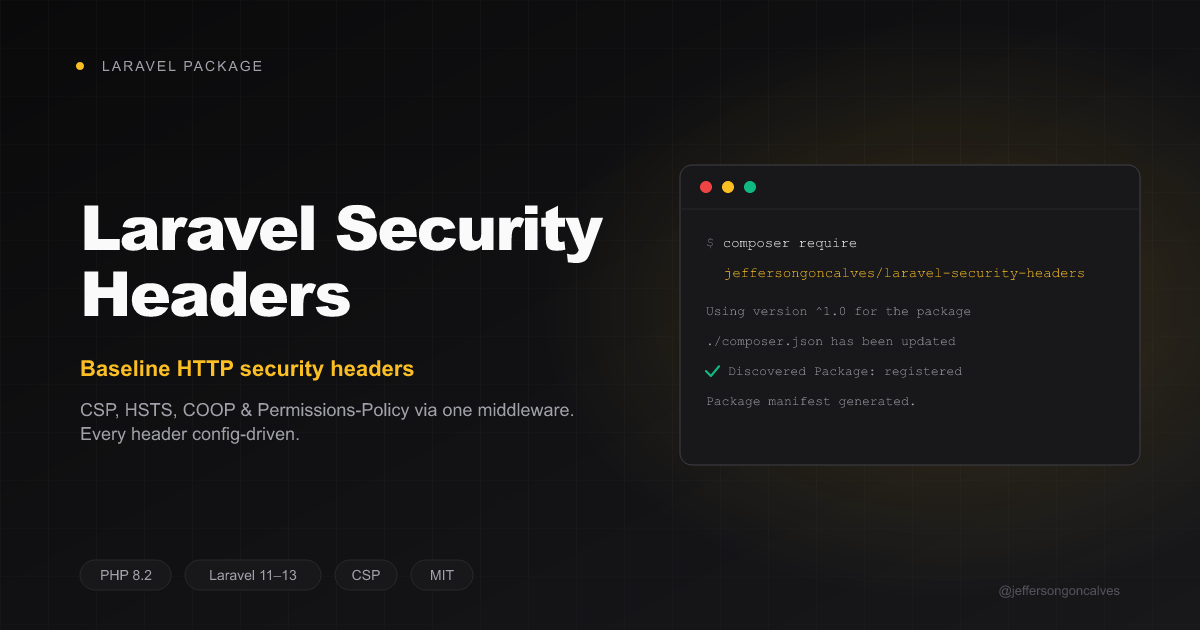
Laravel Security Headers
This Laravel package stamps a configurable set of baseline security headers onto your HTTP responses via a single middleware. Every header value and the full Content-Security-Policy directive map are driven by config/security-headers.php, so you can tune or disable each one without touching code.
The headers it manages:
X-Content-Type-OptionsX-Frame-OptionsReferrer-PolicyPermissions-PolicyContent-Security-PolicyCross-Origin-Opener-PolicyX-Permitted-Cross-Domain-PoliciesStrict-Transport-Security(HSTS) — only over real HTTPS and never in thelocalenvironment
Installation
You can install the package via composer:
composer require jeffersongoncalves/laravel-security-headers
You can publish the config file with:
php artisan vendor:publish --tag="laravel-security-headers-config"
Usage
The package ships a single middleware: JeffersonGoncalves\SecurityHeaders\Middleware\SecurityHeaders. Register it however you apply security to your responses. Place it as the outermost middleware of the group you want protected so it also stamps cached (HIT) responses produced further down the stack.
Register an alias and/or apply to a group (Laravel 11+)
In bootstrap/app.php:
use Illuminate\Foundation\Configuration\Middleware;
use JeffersonGoncalves\SecurityHeaders\Middleware\SecurityHeaders;

->withMiddleware(function (Middleware $middleware) {
    // Apply to the whole web group...
    $middleware->web(prepend: [
        SecurityHeaders::class,
    ]);

    // ...or register an alias and attach it per route/group.
    $middleware->alias([
        'security-headers' => SecurityHeaders::class,
    ]);
})
Then, with the alias, on a route or group:
Route::middleware('security-headers')->group(function () {
    // ...
});
Legacy kernel (Laravel 10 style)
Add the middleware to a group in app/Http/Kernel.php:
protected $middlewareGroups = [
    'web' => [
        \JeffersonGoncalves\SecurityHeaders\Middleware\SecurityHeaders::class,
        // ...
    ],
];
Configuration
After publishing, config/security-headers.php exposes three blocks.
Static headers
Each entry is stamped onto every response. Set any value to null to skip that header:
'headers' => [
    'X-Content-Type-Options' => 'nosniff',
    'X-Frame-Options' => 'SAMEORIGIN',
    'Referrer-Policy' => 'strict-origin-when-cross-origin',
    'Permissions-Policy' => 'camera=(), microphone=(), geolocation=(), payment=(), usb=(), browsing-topics=()',
    'Cross-Origin-Opener-Policy' => 'same-origin-allow-popups',
    // Disable a header by setting it to null:
    'X-Permitted-Cross-Domain-Policies' => null,
],
Customizing the Content-Security-Policy
The CSP header is assembled from the associative directives map, preserving order. A value may be a string or an array of source expressions. A directive whose value is null (or an empty string) is emitted as a valueless directive (e.g. upgrade-insecure-requests). Set csp.enabled to false to drop the header entirely:
'csp' => [
    'enabled' => true,
    'directives' => [
        'default-src' => "'self'",
        'script-src' => ["'self'", "'unsafe-inline'", 'https://www.googletagmanager.com'],
        'img-src' => "'self' data: https:",
        'frame-ancestors' => "'self'",
        'object-src' => "'none'",
        'upgrade-insecure-requests' => null, // valueless directive
    ],
],
HSTS
Strict-Transport-Security is only stamped over real HTTPS and never while the app is in the local environment (a cached max-age on a *.test domain is a pain to undo):
'hsts' => [
    'enabled' => true,
    'max-age' => 31536000,
    'include-subdomains' => true,
    'preload' => true,
],
Security caveat: the CSP is not an XSS backstop
The default CSP is deliberately permissive on script-src/style-src — it keeps 'unsafe-inline' and 'unsafe-eval' so inline Google Tag Manager / gtag and Alpine.js (which evaluates expressions via new Function) keep working. The protective value is in the structural directives: frame-ancestors (clickjacking), object-src 'none', base-uri/form-action lock-down, and upgrade-insecure-requests.
Because 'unsafe-inline'/'unsafe-eval' remain, this CSP is NOT the XSS backstop for any untrusted HTML you render (third-party content, imported article bodies, READMEs, etc.). Pair it with output sanitization (for example symfony/html-sanitizer) for any such markup — do not treat a permissive script/style CSP as a compensating control. If you do not need inline scripts, tighten script-src/style-src (drop 'unsafe-inline'/'unsafe-eval', adopt nonces/hashes).
Testing
composer test
Changelog
Please see CHANGELOG for more information on what has changed recently.
Contributing
Please see CONTRIBUTING for details.
Security Vulnerabilities
Please review our security policy on how to report security vulnerabilities.
Credits
License
The MIT License (MIT). Please see License File for more information.
统计信息
- 总下载量: 0
- 月度下载量: 0
- 日度下载量: 0
- 收藏数: 1
- 点击次数: 1
- 依赖项目数: 0
- 推荐数: 0
其他信息
- 授权协议: MIT
- 更新时间: 2026-06-20